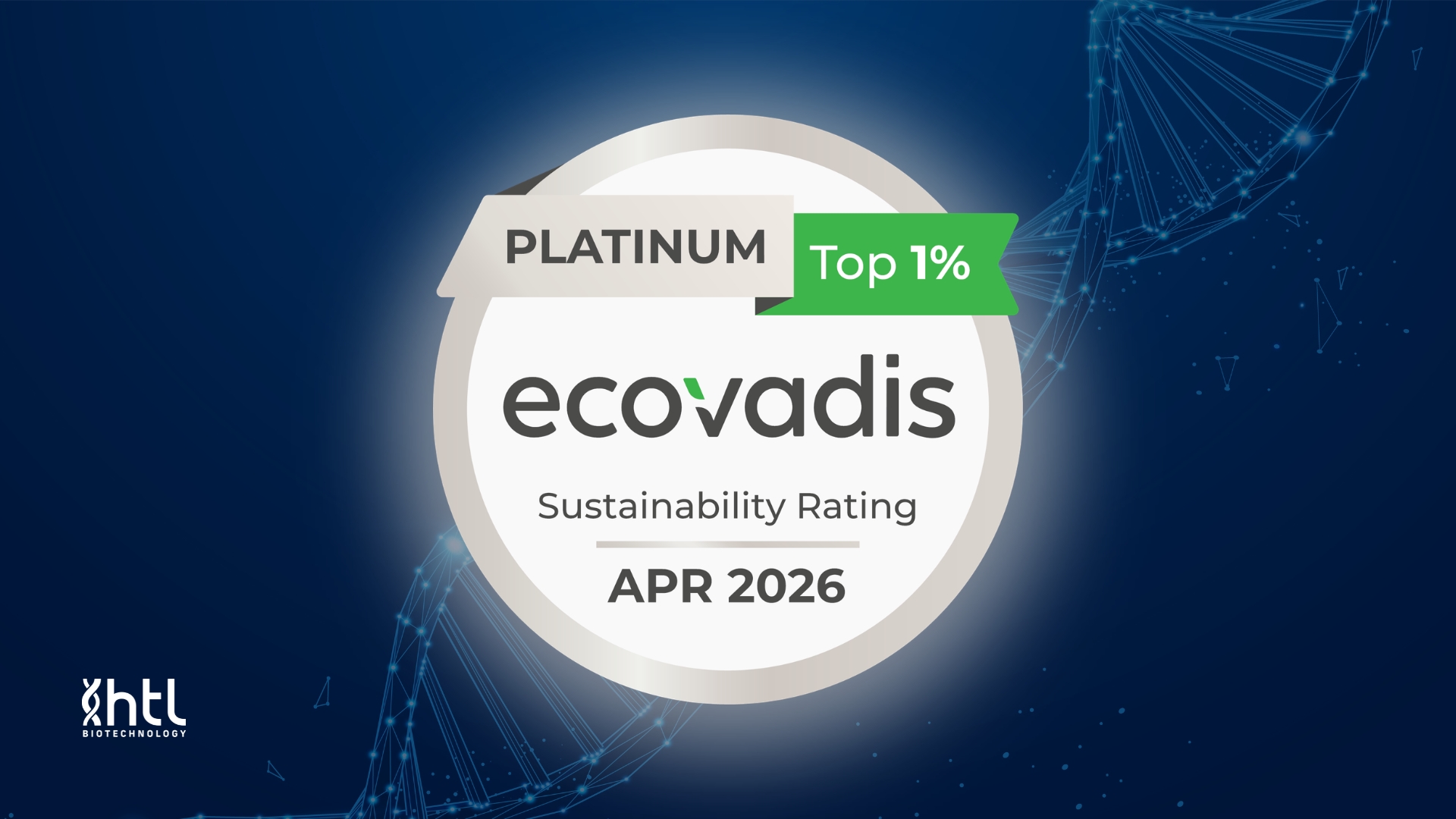
EcoVadis Platinum Level Achieved in 2026
We have renewed our EcoVadis assessment and achieved the Platinum level!

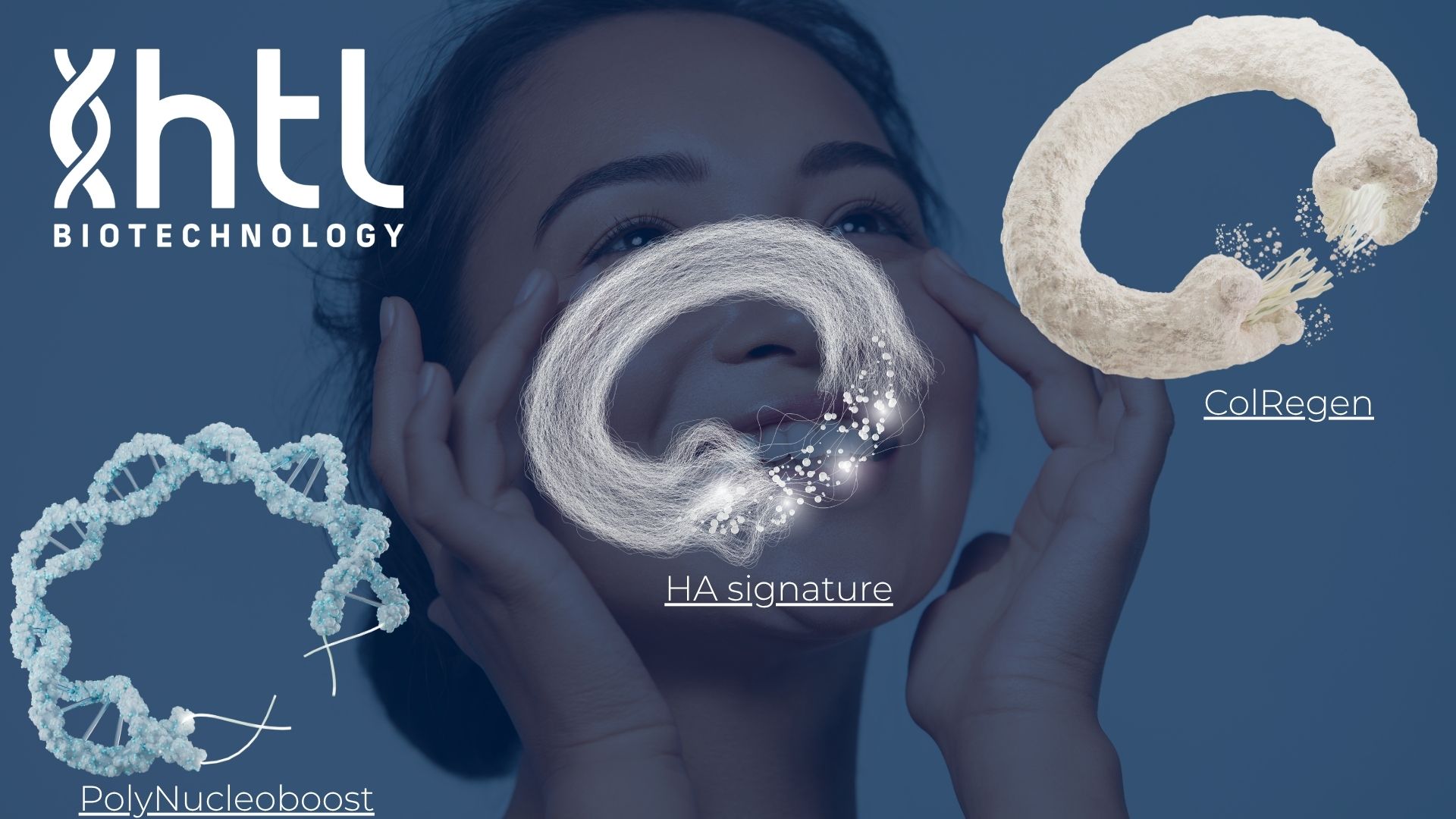
At HTL Biotechnology, we are committed to advancing skin quality through a premium and innovation-driven portfolio built around three key biomolecules that play a central role in aesthetic and regenerative medicine:
Each of these biomolecules contributes differently to skin quality, and together they enable a broad range of medical and aesthetic applications.
HA Signature: Supporting Hydration and Skin Quality
Hyaluronic acid is naturally present in the extracellular matrix and plays a key role in maintaining skin hydration and tissue homeostasis. Thanks to its remarkable water-binding capacity, it has become one of the most widely used biomolecules in aesthetic medicine.
With more than 30 years of expertise, HA Signature is HTL Biotechnology’s premium hyaluronic acid platform, developed to meet the highest standards of quality, performance and consistency.
Offering tailor-made solutions ranging from very low to very high molecular weights, HA Signature supports a wide variety of medical and aesthetic applications. Still today at the forefront of deep regeneration, it reflects HTL Biotechnology’s long-standing expertise and strong Made in France commitment.
ColRegen: A New Generation of Recombinant Collagen
Collagen is one of the main structural proteins of the skin and plays a major role in maintaining firmness and skin architecture. As collagen production naturally decreases over time, supporting skin structure has become an important objective in regenerative aesthetics.
ColRegen is HTL Biotechnology’s next-generation recombinant collagen platform, designed to support advanced skin and tissue regeneration.
Developed to contribute to dermis rebuilding, skin structure and firmness, ColRegen reflects a new approach to regenerative aesthetics and biotechnology. Based on a US-designed molecule and proudly manufactured in France, it combines innovation, performance and safety to meet the evolving needs of aesthetic medicine.
PolyNucleoBoost: Advancing Tissue Regeneration
Polynucleotides have attracted growing interest in regenerative medicine thanks to their ability to support tissue regeneration and improve overall skin quality.
PolyNucleoBoost is HTL Biotechnology’s premium polynucleotide solution, derived from sustainably sourced wild salmon by-products and manufactured through a singular purification process designed to deliver exceptional quality and performance.
Its efficacy in supporting epidermal regeneration has been demonstrated, including under stress conditions, while its safety profile is widely established. Backed by more than 45 years of expertise and proudly Made in France, PolyNucleoBoost reflects HTL Biotechnology’s commitment to innovation, quality and advanced biomolecules for aesthetic medicine.
Three Technologies, One Commitment
Although each biomolecule has its own specific characteristics, they all contribute to a common objective: supporting skin quality through high-quality biomaterials developed for the evolving needs of aesthetic and regenerative medicine.
By combining decades of scientific expertise, advanced manufacturing capabilities and a strong commitment to quality, HTL Biotechnology continues to develop premium biomolecule platforms that support healthcare professionals in delivering innovative aesthetic solutions.
Through HA Signature, ColRegen and PolyNucleoBoost, HTL Biotechnology remains dedicated to advancing skin quality with solutions designed for the future of regenerative aesthetics.

Glaucoma is currently one of the leading causes of irreversible vision loss worldwide. This chronic disease is characterized by progressive damage to the optic nerve, with elevated intraocular pressure being the main modifiable risk factor for disease development and progression. Management relies on the daily administration of pressure-lowering treatments in the form of eye drops to slow disease progression. Although these treatments have demonstrated their efficacy, their long-term use remains challenged by a major issue: treatment adherence, due in part to the physiological limitations of conventional ocular drug administration.
In response to these limitations, the development of new ophthalmic drug delivery technologies aims to improve drug residence time in the eye and ensure a more consistent release of the active pharmaceutical ingredient. Among these innovations, ophthalmic inserts are emerging as a promising technology. [1]
Hyaluronic acid (HA) has become the dominant biomaterial in injectable soft tissue augmentation, with millions of treatments performed annually worldwide. As a naturally occurring glycosaminoglycan composed of repeating disaccharide units of D-glucuronic acid and N-acetyl-D-glucosamine, native HA possesses exceptional biocompatibility, hygroscopicity, and viscoelastic properties. However, in its unmodified state, HA is rapidly degraded in vivo by endogenous hyaluronidases and reactive oxygen species, with a tissue half-life measured in hours to days. [1,2]
To overcome this limitation and create materials suitable for lasting soft tissue correction, HA must be chemically cross-linked. This process transforms a fluid polysaccharide solution into a structured hydrogel with tuneable mechanical and biological properties. The chemistry of cross-linking is, in many respects, the defining step that determines how a dermal filler will perform in the hands of a clinician and in the tissues of a patient. [2,3]

On January 29, 2026, during IMCAS World Congress in Paris, HTL Biotechnology hosted its first scientific session dedicated to the future of regenerative and aesthetic medicine.
Bringing together experts from industry and clinical practice, the session explored how advanced biopolymers are helping shift aesthetic medicine toward a more regenerative approach, focused on skin quality, tissue repair, and long-term biological function.